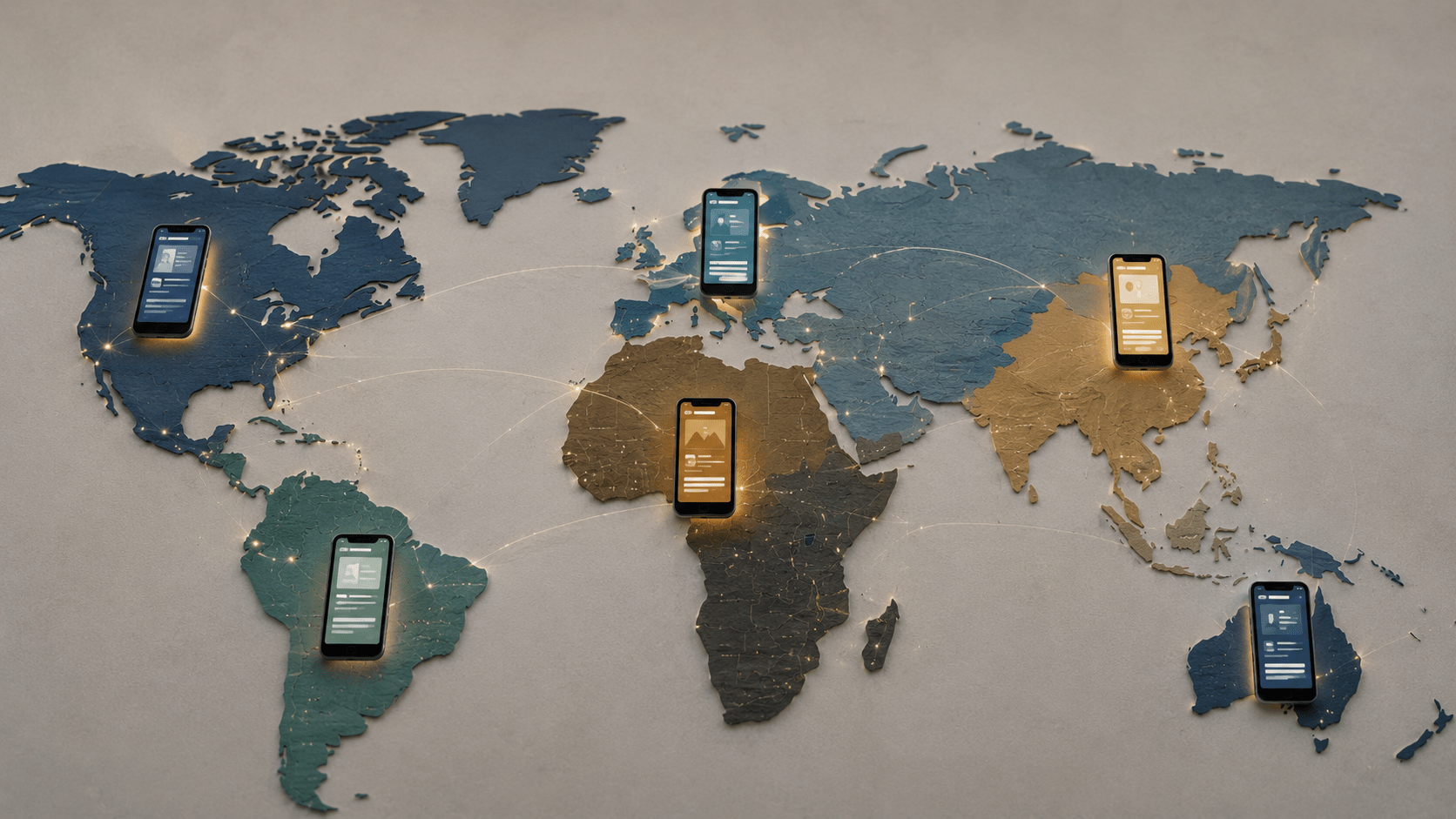
Mobile gaming is genuinely global, but the games people actually open every day are not the same from one region to the next. The worldwide revenue charts are dominated by a handful of giants, yet local download charts tell a more interesting story: a Tencent MOBA rules in China, a board game adaptation rules family game nights in India, and a fruit-merging puzzle quietly took over Australian commutes.
This guide walks through what people are playing across six continents in 2026, with a note on why. If you only know your own local charts, some of these will be unfamiliar. That is the point.
A quick caveat before the list. “Top” can mean most downloaded or most money spent, and the two rarely match. The US accounted for 31% of global mobile game revenue in January 2026, the largest single-market share, but India led on downloads. Revenue figures and rankings shift month to month, so treat the specific numbers here as current as of writing, not permanent.
Asia: where the money and the players concentrate
Asia dominates mobile gaming on both spending and player count, but the picture splits sharply between China and India.
In China, Tencent’s Honor of Kings was the world’s top-grossing mobile game in March 2026, taking in $190.3 million, up 23.1% year over year. It is a five-versus-five MOBA, meaning two teams of five players each push toward the other’s base. If you have never played one, think of it as a fast, competitive team game built around short matches and deep character rosters.
India tells a different story, and it is less about money than sheer scale. India led the world with 607 million mobile game downloads in January 2026, about 14.4% of the global total. The games topping Indian charts skew toward accessibility on low-cost phones. Battlegrounds Mobile India leads with over 240 million downloads, while Garena Free Fire Max draws players with fast matches suited to mid-range phones. Both are battle royale games, where dozens of players drop onto a map and fight until one is left standing.
The standout in India is not a shooter, though. Ludo King, a digital version of the ancient Pachisi board game, crossed 1.75 billion global downloads by March 2026 and once reached 51 million daily active users. It is a family game, played online or locally with voice chat, and it became a fixture during lockdowns that never went away.
Europe: casual puzzles and the quiet strategy money
Europe’s charts reward two very different things: puzzle games pull the downloads, strategy games pull the spending. Across Europe in 2025, strategy generated over $629 million in year-over-year in-app purchase revenue and puzzle added over $706 million, the two largest positive genre movements in the region.
On downloads, Block Blast was the most popular game in the UK in 2025 with 4.6 million downloads, a simple block-fitting puzzle in the same family as old Tetris-style time-killers. Beyond it, the casual match-3 genre runs the table: Royal Match and Candy Crush Saga lead across much of Europe, with Coin Master strong in Germany, Poland, Portugal, Spain, Italy, Greece and Romania. Match-3 means swapping tiles to line up three or more, the mechanic behind most of the colorful puzzle ads you have seen.
It is worth noting how concentrated European development is. The region hosts around 5,300 game studios and 200 publishers, with hubs in Sweden, Finland, France, Poland and Germany, and the European mobile gaming market was projected to reach $13.95 billion in 2025.
North America: monetization over installs
North America behaves like a mature market: not many new players, but the ones already there spend heavily. Block Blast was the most popular game in the United States in 2025, with 10 million more downloads than second-place Roblox. Roblox is less a single game than a platform of user-created experiences, which is part of why it stays near the top on engagement rather than novelty.
On the spending side, Roblox remains among the highest-grossing titles in North America, sustained by an active user-generated content economy, with US growth driven by revenue per user rather than install volume. In plain terms: the American market grows by getting existing players to spend more, not by finding new ones.
South America: Brazil sets the tone
Brazil is the engine of Latin American mobile gaming. As of September 2025 there were roughly 93.1 million gamers in Brazil, with mobile phones the most popular device, and Mexico second at 66.7 million.
What Brazilians play leans social and free-to-play. Roblox topped Brazil’s mobile charts, followed by a Free Fire and Naruto Shippuden crossover, Coin Master, Candy Crush Saga and Royal Match. Free Fire’s strength here is not a coincidence: it continued strong performance across Southeast Asia and Latin America in early 2026. The game’s low device requirements and short matches map neatly onto markets where mid-range phones are the norm.
Africa: mobile-first by a wide margin
Africa is the most mobile-dependent gaming region in the world, and it is growing faster than the global average. The African gaming market hit $2.3 billion in 2026, growing at 12.32% annually against a global average of 7.5%, with about 87% of African gamers playing on smartphones. Egypt leads the continent at $368 million in revenue, followed by Nigeria at $300 million, South Africa at $278 million and Kenya at $46 million.
In Nigeria, the most-played titles share two traits: they run on low-spec phones and they sip data. Call of Duty: Mobile and Free Fire MAX lead in downloads and daily active players, with games like Free Fire Lite, PUBG Lite and Ludo King optimized for low-end devices. Football also carries real weight as a genre here, reflecting local sporting culture rather than imported trends. Ludo King’s presence across both India and Nigeria is a small reminder that a simple, data-light board game can outrun far flashier titles in much of the world.
Oceania: competitive matches meet casual fads
Australia balances competitive multiplayer with the same casual viral hits seen elsewhere. PUBG Mobile remains one of the most downloaded titles in Australia, with battle royale, strategy, casual and simulation genres all prominent on local charts.
The more telling Australian story in 2026 is a fad. The Watermelon Game, also called Fruit Merge, exploded in popularity on a dead-simple concept: drop fruit into a container, and matching fruit combine into bigger fruit. It is the kind of game that spreads by being watched on a train rather than marketed, and it captures something true about mobile gaming everywhere: the games that win are often the ones easiest to pick up for ninety seconds.
The throughline
Two patterns hold across every continent. The biggest global earners cluster in a small group of live-service games that update constantly and monetize existing players hard. But the games people actually reach for daily are shaped by local conditions: phone quality, data cost, cultural fit, and whatever happens to be going viral that month. A board game from ancient India and a fruit-merging puzzle have as much claim to “top phone game of 2026” as any billion-dollar MOBA, depending on where you are standing.
Revenue and download figures reflect early-to-mid 2026 reporting and may shift. All figures were current at time of writing.