
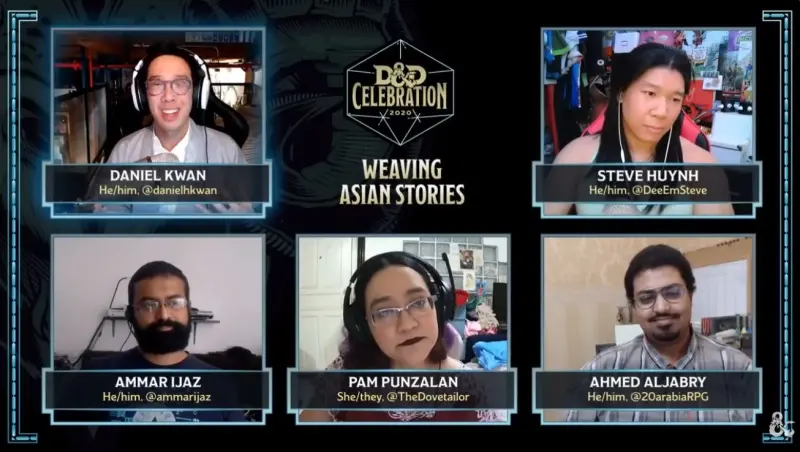
This panel brings together five Asian game designers and storytellers to discuss how D&D and other tabletop RPGs have historically portrayed Asian cultures, why those portrayals cause harm, and what players and designers can do differently. Moderator Daniel Kwan, co-host of the Asians Represent podcast and a Chinese Canadian designer based in Toronto, is joined by Steve Huynh, a Canadian Vietnamese author and D&D enthusiast; Ammar Ijaz, co-host of Asians Represent and facilitator of a critical reading series on the Al-Qadim sourcebook; Pamela Punzalan, a queer Filipino designer based in Manila who coordinates the RPG Sea community for Southeast Asian tabletop creators; and Ahmed Aljabry, a Saudi Arabian translator and community builder working to bring Arabic and Islamic cultural context into the RPG space. The conversation draws on a 26-hour streaming event the group ran on Twitch, reading through older D&D sourcebooks with Asian settings alongside creators from around the world.
What a stereotype actually does
The panel opens with a question about what stereotypes are and how they function, and the answers from different panelists are worth holding together. One framing: a stereotype is what happens when the human instinct to recognize patterns gets applied to people’s identities rather than neutral observations. When that happens, the pattern replaces the person. A second framing, from someone with a psychology background: stereotypes are not neutral descriptions. Once you accept one, you become resistant to information that contradicts it. New evidence gets forced into the existing category rather than updating the category itself.
The third framing, from Ahmed, is the most concrete: he is Arab and Muslim. Because he is Arab, he gets grouped with Persians and Turkish people. Because he is Muslim, he gets grouped with Malay, Indonesian, and North African people. A single label gets applied to an enormous and internally diverse set of cultures, experiences, and histories — and in the process, most of what is actually there disappears.
The panel is careful to distinguish between harm that comes from malicious intent and harm that comes from an incomplete understanding of how stereotypes work. The older D&D sourcebooks being discussed were not written by people trying to cause harm. They were written by people who appreciated certain aspects of Asian culture and wanted to incorporate them into fantasy settings. The problem is that appreciation filtered through a single outside perspective, without meaningful input from people inside those cultures, produces reduction rather than richness. A feature that exists in many forms across a diverse set of cultures gets flattened into a single exotic marker.
Rice is the example the moderator uses: books set in Asian-inspired fantasy worlds sometimes treat “have you eaten rice today?” as a common greeting, when there are significant parts of Asia where rice is not a dietary staple at all. The stereotype exists not because the writers were wrong to associate rice with parts of Asian culture, but because they applied it universally and made it load-bearing in world-building rather than treating it as one data point among many.
What happens when you make culture a game mechanic
The panel spends significant time on a specific example from the D&D 5th Edition Dungeon Master’s Guide: an optional Honor score. The text reads, in part, that Honor fits well in settings inspired by Asian cultures such as Kara-Tur in the Forgotten Realms. The guide does note elsewhere that Honor could also apply to orders of knights, but the primary association established is with Asian cultures broadly.
The problems the panel identifies are layered. The first is the blanket statement — honor as a cultural value is applied to “Asian cultures” as a category rather than to any specific culture or context. The second is what happens when you turn a living cultural value into a numerical score. Ahmed’s response is direct: the idea of honor is something present in his daily life, in how he treats people, in how he moves through the world. It is not a set of points. It is not something that accrues or depletes on a character sheet. Making it a mechanic strips away everything that gives it meaning.
The point is sharpened by Pamela’s contribution. Southeast Asia is largely invisible in the legacy D&D sourcebooks being discussed, despite being a vast and internally varied region. The Philippines alone has its own version of what might be approximated as honor — a concept called delicadeza, which she describes as involving simultaneous navigation of what your family needs, what you need, and what is socially acceptable within your community. Those are three distinct layers of obligation that interact with each other in ways that shift based on context. Gamifying that from the outside, without genuine understanding of how those layers work, would not produce an Honor score. It would produce a misrepresentation of something far more complex.
The panel draws a parallel to a broader discussion that has happened in the tabletop community about whether love and companionship should be mechanized in D&D. The same questions apply: what is lost when an emotional, relational, culturally embedded experience becomes a trackable number? The answer, in both cases, is most of what makes it interesting.
The “other” and the monstrous
Pamela offers one of the panel’s most precise observations when discussing how legacy sourcebooks handle monsters and creatures from non-Western mythologies. The underlying message in many older texts, she argues, is not just that the other is strange — it is that the other can be conquered. That framing is not incidental. It maps directly onto colonial logic: an unfamiliar culture is presented as exotic, dangerous, and ultimately available to be defeated, looted, and learned from — on the terms of the person arriving, not the people already there.
For the Philippines, this is not an abstract concern. The country has a colonial history involving Spain, Britain, Japan, and America. The experience of being defined by outsiders as something to be civilized, converted, or defeated is part of living memory, not distant history. When game material presents creatures drawn from Filipino mythology as monsters to be overcome by adventurers, it is operating within that same logic whether or not anyone involved intends it to.
Steve’s contribution here draws on a blog post from Throne of Salt about real animals that were described as monsters in colonial-era accounts — lions and tigers that evaded traps and attacked British colonial settlements in ways that seemed almost supernatural. When researchers studied them, they found animals riddled with old bullet wounds, with damaged teeth, unable to catch their normal prey, starving and desperate. They were not monsters. They were the products of a colonial environment that had damaged the ecosystems they depended on. The argument applied to RPG monsters: what appears monstrous usually has a cause, a context, and a story that the monster framing forecloses.
The moderator offers an example of what an alternative approach looks like: the mingxia, a creature from Chinese folklore described as a tiny four-winged snake that lives near jade and gold deposits and whose voice sounds like chiming bells. Historically associated by travelers with nearby treasure. An adventure built around befriending or locating a mingxia to find a jade relic would use the creature’s actual cultural context rather than assigning it an alignment and making it an obstacle to defeat. The creature’s relationship to the world it comes from is the story — not its threat level.
Southeast Asia’s specific invisibility
One of the panel’s recurring themes is that discussions of Asian representation in tabletop games tend to focus on East Asia — Japan, China, Korea — to the effective exclusion of South Asia and Southeast Asia. Pamela makes this explicit: Oriental Adventures, the AD&D sourcebook the group has spent considerable time analyzing, renders Southeast Asia almost entirely invisible. This despite Southeast Asia being home to hundreds of millions of people across countries that are dramatically different from each other in language, religion, history, food, social structure, and mythology.
The practical consequence for players and designers who want to engage with these traditions is that the most commonly available reference points are either absent or filtered through a generalized “Asian” category that does not meaningfully distinguish between, say, Filipino Catholic coastal fishing culture and Japanese Shinto mountain traditions. The resources that do exist tend to come from within those communities rather than from mainstream publishing. The panel points specifically to the A Thousand Thousand Islands zine series as an example of Southeast Asian-created fantasy world-building that draws on real regional traditions without exoticizing them.
The same issue applies to the Middle East and the Arab world. Al-Qadim, the AD&D sourcebook set in an Arabian Nights-inspired setting that several panelists have been reading critically together, contains what Ahmed describes as genuine treasures — detailed research, thoughtful world-building, a real attempt to engage with Arabic culture. But the presentation frames the setting as a place of “exotic goods and strange magic” available to outsiders who travel there to profit. The invitation to engage with the world is structured as an invitation to extract from it. That framing, however unintentionally, encodes a colonial relationship between the reader and the culture being portrayed.
What you can actually do
The panel closes with practical suggestions, and they are more concrete than the usual advice in these conversations. On playing Asian characters, the clearest guidance is also the simplest: do not do the accent. Not because accents are inherently offensive, but because a generic “Asian accent” erases the enormous diversity of how people actually speak across the continent and its diaspora, signals that the character is primarily a cultural symbol rather than a person, and draws attention away from everything that would actually make the character interesting — their beliefs, their family obligations, their relationship to food, their specific history.
Steve’s recommendation for preparation is films and television, specifically recent East Asian productions available on streaming platforms. Kingdom, Train to Busan, and other Korean productions are cited as works that give non-Asian viewers a grounded sense of what people from those cultures value, fear, and navigate socially — in a form that engages emotion and intuition rather than just providing information. The caveat is honest: watching Korean dramas will not make a non-Korean person able to authentically play a Korean character. But it will make them a better storyteller in general, and it will reduce the likelihood that they default to stereotypes because those are the only reference points they have.
Ammar’s suggestion addresses Asian players specifically: play an Asian character. Bring the culture you know to the table rather than assuming your character needs to be coded as white or European to fit into a fantasy world. Bring the food you grew up with to game night. Let your actual lived experience be part of the game.
Pamela’s advice flips the perspective for non-Asian players: your own culture is interesting. One reason people reach for exoticized versions of other cultures is the sense that their own culture is too familiar to be interesting in a fantasy context. That sense is incorrect. Every culture has mythology, history, social complexity, and narrative material worth building from. Starting from what you know and understand well is not a limitation — it is a foundation. The risk of cultural appropriation, she suggests, decreases significantly when people are genuinely curious about other cultures rather than assuming those cultures are automatically more interesting than their own.
Ahmed’s suggestion is the smallest in scope and perhaps the most actionable: start with something specific and let it expand. Extended family structures are his example. In many Western contexts, a family of two or three children and two parents is the default assumption. His family of nine people is not unusual in his cultural context. What does it mean to have a character whose identity is shaped by deep obligations to cousins, second cousins, and extended family networks several branches removed? That is a single cultural detail. But explored honestly, it generates more interesting characters than any amount of generic “honor score” mechanics.
Resources recommended by the panel
The panelists recommend a range of resources across academic and game contexts. For foundational understanding of how Western scholarship has constructed Asian cultures as exotic and other, Orientalism by Edward Said is the starting point — a dense but foundational text of postcolonial studies that makes visible the frameworks that shaped how Asia has been portrayed in Western media for centuries.
For game-specific resources created by Asian designers: Unbreakable Vol. 1, an anthology of D&D 5e one-shot adventures written and illustrated by Asian creators, is recommended specifically as a study text — reading how Asian designers construct their settings reveals a kind of cultural nuance that is difficult to convey through instruction alone. A Thousand Thousand Islands offers Southeast Asian-inspired fantasy world-building zines that are described as genuinely mind-expanding by multiple panelists. The Islands of Sina Una provides a Philippines-rooted TTRPG setting. For Arabic and Islamic cultural context in historical settings, The Sealed Nectar is recommended for its detailed portrait of the social structure of the Arabian peninsula. For Chinese history as a design resource, The Formation of Chinese Civilization: An Archaeological Perspective is described as essential.
The blog post D&D Doesn’t Understand What Monsters Are by Throne of Salt and the essay May I Play a Character From Another Race? by James Mendez Hodes are also cited as valuable shorter reads that address specific aspects of the panel’s themes.
The full panel is available on the Asians Represent YouTube channel. The Asians Represent podcast and community can be found at @aznsrep on Twitter and on Twitch. Individual panelists are active on Twitter: Daniel Kwan at @danielhkwan, Ammar Ijaz at @amarijaz, Ahmed Aljabry at @twentyarabiarph, and Pamela Punzalan via the RPGSea community.