World Order asks you to run a global superpower. Not metaphorically, specifically: you play as the United States, China, Russia, or the European Union, competing for influence across seven regions using a mix of area control, deck-building, and hand management. It’s designed by Vangelis Bagiartakis and Varnavas Timotheou, the team behind Hegemony: Lead Your Class to Victory, a game that landed in BoardGameGeek’s top 50 of all time. World Order funded through Kickstarter and Gamefound with more than 13,000 backers and over €2,000,000 raised, so the appetite for this kind of game clearly exists. Whether the game itself earns that appetite, and whether its framing of “the world” holds up for a global audience, are two separate questions worth answering separately.
How it plays
Each round, players take turns playing a single card from a hand of six, using it either for its written effect, discarding it for cash, or spending it on a once-per-game special ability. Actions cover improving relations with allied countries, building military bases, trading resources, and investing in development. After four cards, players move into a Research phase to buy new cards for their deck. Turn order each round is decided by score, with the lowest-scoring player choosing their position first, which is a small but effective way of keeping a losing player engaged rather than just watching the leader run away with it.
The four powers do not play identically. Russia and the US lean toward military actions; China and the EU lean toward economic development. The asymmetry comes from a genuinely small number of rule additions rather than four separate rulebooks, which is one of the more impressive pieces of design work here. The US needs a majority of influence across a wide number of regions to avoid losing points. Russia needs military strength specifically within its zone of interest. The EU and US don’t threaten each other under a NATO restriction built into the rules, which also determines who can play whom in a two-player game: one player must take the US or EU, the other must take China or Russia.
What reviewers found
Reception has been positive with real reservations. Meeple Mountain’s review, written by someone who rates Hegemony as one of the best games he’s played, was more measured on World Order specifically, noting that despite the shorter, more approachable rules, the actual playtime runs long enough that he’d reach for Hegemony first on future game nights. A widely discussed BoardGameGeek write-up scored the game 9 out of 10 but flagged genuine friction points: development cards that rarely factor into a winning strategy, and military strength mattering more than the game’s marketing suggests, to the point that ignoring it can cost twenty points in a single game. That same review also pushed back on the idea that the game lacks player interaction, noting real tension around resource trades between powers, particularly oil, which the EU is chronically short of and Russia is happy to supply.
A separate early preview from Talking Shelf Space, written before the Kickstarter campaign, praised the game’s coherence and the way asymmetric national behavior emerges from just a handful of rule tweaks rather than bolted-on complexity. The same review raised something worth sitting with directly: some players will be uncomfortable with a game that lets you play as a nation whose real-world actions they find genuinely objectionable. The reviewer’s response was that the game doesn’t ask you to endorse anything, it asks you to understand why a system behaves the way it does. That is a reasonable defense of the format, but it doesn’t fully answer the question of who the format includes and excludes in the first place.
The part worth assessing for a global audience
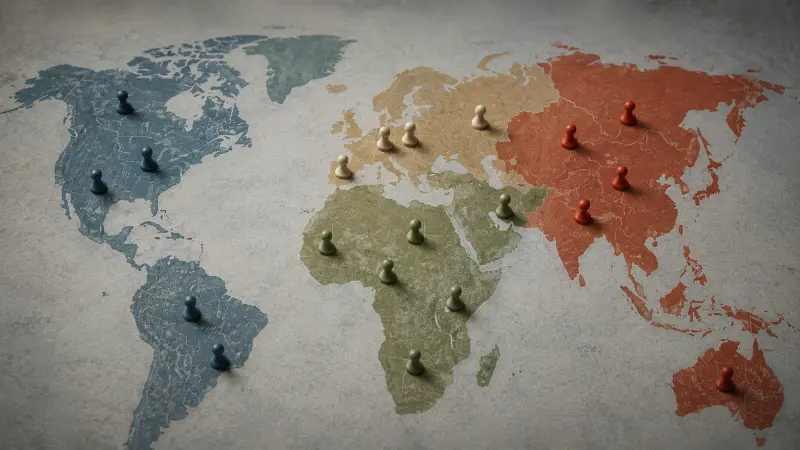
Here is the more pointed issue. World Order’s premise is that there are exactly four powers worth simulating: the US, China, Russia, and the EU. That is a specific and debatable claim about how the world actually works, not a neutral starting point. India, with the world’s largest population and a rapidly growing economy, isn’t a playable power. Neither is any African, Southeast Asian, or Latin American state, despite those regions containing the large majority of the world’s population and an increasing share of its economic and diplomatic weight. The game’s own rulebook restricts the two-player mode along a “Western versus Eastern” axis, US or EU against China or Russia, which encodes a Cold War-era framework onto a board explicitly set in the 2010s.
To be fair to the designers, this isn’t an oversight so much as a design choice with a real justification: those four actors are, by most conventional measures of hard power, the dominant blocs in the specific international system the game models. And the Talking Shelf Space reviewer raised the same gap independently, expressing hope for an eventual expansion adding India as a fifth power, which suggests the designers themselves may be aware of the limitation. An expansion, World of Turmoil, has already been released to update the base game with more recent geopolitical shifts, so the system is clearly built to evolve rather than stay frozen at its 2010s starting point.
Still, a game that bills itself as “the ultimate international relations simulator” while giving a build slot to exactly four actors is making an argument about global power, whether it intends to or not. For a reader outside those four blocs, that argument is worth noticing rather than accepting as neutral world-building.
Who should actually buy this
If you enjoy dense political-economy games, have three friends willing to commit a genuinely long session (this consistently runs over an hour per player, and is best at exactly four), and are specifically interested in modern geopolitics, diplomacy, or international relations as a subject, this is built for you with real care. If you want something with heavier direct negotiation and roleplaying at the table, Hegemony is probably still the better pick from the same designers, based on multiple reviewers who’ve played both. And if you’re looking for a game that reflects the world in a genuinely global way rather than a great-power framing, know going in that this is not that game, and treat the geopolitical premise as a specific, contestable design choice rather than a neutral map of the world as it is.
Players: 2 to 4 (best at 4)
Play time: Roughly 60+ minutes per player
Designers: Vangelis Bagiartakis, Varnavas Timotheou
Publisher: Hegemonic Project Games
Released: 2026