Play helps children build executive function, self-control and social understanding, according to a substantial body of developmental research, though the strength of the evidence differs by type of play. The American Academy of Pediatrics (AAP) clinical report The Power of Play, first published in 2018 and reaffirmed in January 2025, says play is “not frivolous” and ties it to brain structure and function, executive function and prosocial behavior.
This article covers physical play, pretend play, board and card games, and traditional games. Digital games are a separate body of research that it does not cover; GameBridges looks at one part of it in our article on older adults and video games. Where a finding comes from a randomized trial, the text says so, and where it comes from observation alone, the text says that too.
Physical play: outdoors, movement and risk
Outdoor Play Canada’s 2025 position statement on active outdoor play draws on 18 systematic reviews and was reviewed by more than 200 experts worldwide, according to Queen’s University’s summary. It links active outdoor play to physical activity, sleep and confidence, and says that for children it supports learning through exploration and challenge. The statement covers people of all ages, not only children.
Rough-and-tumble play, such as wrestling and chasing, is often restricted for safety reasons. This article could not locate experimental evidence on its benefits or risks, so it makes no claim either way.
Free play, pretend play and self-regulation
Pretend play is among the most studied forms of play. A parent-facing article from the Child Mind Institute says it “appears to support” the development of theory of mind, the understanding that other people have beliefs and feelings different from your own. One proposed explanation is that a child who treats a block as a car must hold two ideas at once and coordinate them with a play partner.
The psychologist Lev Vygotsky argued that pretend play lets children act above their usual level, in what he called the zone of proximal development. A child playing shopkeeper has to follow rules, take turns, keep a story going and manage emotions at the same time.
A study of 2,213 Australian children, published in Early Childhood Research Quarterly in 2022, relied on parents’ 24-hour time diaries. Children who spent more time in unstructured quiet play at ages 2 to 3 and 4 to 5 had better self-regulation at ages 4 to 5 and 6 to 7, even after the researchers controlled for earlier self-regulation and other known predictors. For preschoolers, one to five hours of unstructured active play predicted self-regulation two years later. This is observational work: it shows an association that survives statistical controls, not that play caused the difference.
A meta-analysis of 34 studies of children aged 3 to 8, reported in a 2025 Vrije Universiteit Amsterdam thesis, found a positive but small relation between pretend play and social competence. Most of the included studies were cross-sectional, so they cannot show which comes first, and socially skilled children may simply play more complex pretend games. The relation was stronger when studies measured the quality of pretend play, such as how complex a scenario was, than when they measured time spent.
Board and card games: structured play and executive function
Executive function is a cluster of skills that includes working memory, cognitive flexibility and inhibitory control: holding information in mind, switching between rules, and resisting impulses. These skills matter in school and in social life, which is why many play studies use them as outcomes.
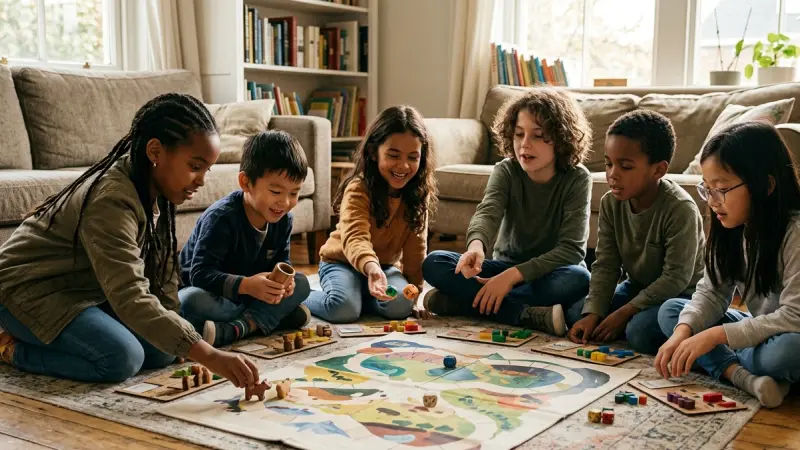
A randomized trial of 68 children aged 7 to 12 in Spain, published in the journal Children in 2023, compared nine weeks of games chosen to exercise executive functions, such as Jungle Speed and Ghost Blitz, with games chosen for other mental skills, such as Dixit and Story Cubes. The children came from households at risk of social exclusion. Both groups improved on cognitive flexibility and inhibition. On one working-memory measure the comparison group improved more, the opposite of what the authors expected. They note that the trial had no group that played no games, so it cannot show how much of the improvement came from the games themselves.
A larger cluster-randomized trial of 522 primary school students in grades one to six, published in Learning and Instruction in 2024, compared board games played in class with regular lessons. The board game group improved more in updating, a working-memory skill, and in reading and mathematics. The authors suggest that modern board games in class may support learning better than direct instruction, a claim that one trial cannot settle.
Both trials are short relative to a childhood, and this article found no long-term follow-up of their effects. Whether the gains last is not known.
Traditional and cultural games
Every culture has play traditions, and they are not interchangeable. Kabaddi in South Asia, mancala-family games across Africa and Asia, and regional tag and circle games each carry their own physical demands, social structures and rules. GameBridges’ board game history quiz covers older games such as chess, Go and backgammon.
This article could not locate a review comparing the developmental effects of traditional games across cultures, so what can be said here is descriptive. When an older child teaches a younger one a local game, rules and norms pass on through practice, an effect that outcome studies like those above do not measure. The two studies above whose countries are described come from Australia and Spain, and this article found no evidence on whether their results hold in other cultures.
Free play and structured play
The AAP report emphasizes play that children direct themselves, in which they practice making decisions and managing conflict without an adult stepping in. The board game trials show short-term executive function gains from structured games, while the Australian time-diary study links self-directed play to later self-regulation. The two kinds of evidence use different designs, and neither shows that one kind of play can replace the other.
The longest follow-up described in this article is the two-year gap in the Australian study. This article found no study that tracked children from early play to adult outcomes.
Vocabulary
- Executive function
- A set of mental processes that help people manage their thoughts and actions, including working memory (holding information in mind while using it), cognitive flexibility (switching between tasks or rules) and inhibitory control (resisting impulses).
- Theory of mind
- The ability to understand that other people have beliefs, intentions, feelings and perspectives that may differ from your own. It typically develops in early childhood.
- Self-regulation
- The ability to manage your own emotions, behavior and attention in response to demands from the environment. It is an internal capacity, not just obeying rules imposed from outside.
- Zone of proximal development
- A concept from the psychologist Lev Vygotsky describing the gap between what a child can do alone and what the child can do with support or in a stimulating context.
- Inhibitory control
- The ability to suppress an automatic response in favor of a more considered one, such as pausing to think about the best move in a board game instead of grabbing the first option.
- Cognitive flexibility
- The ability to switch between tasks, rules or ways of thinking, for example when a game changes its rules mid-round.
- Prosocial behavior
- Actions intended to benefit others, such as sharing, cooperating, helping and showing empathy.
- Randomized controlled trial
- A study in which participants are assigned to groups by chance and the groups are then compared. Random assignment makes it easier to say that a difference between the groups was caused by the intervention.
- Cross-sectional study
- A study that measures people at one point in time. It can show that two things go together, but not which one came first.
- Correlational research
- A type of study that examines whether two variables are related without establishing that one causes the other. A link between pretend play and social skills, for example, does not show which one drives the other.
Related Links
Discussion Questions
- Growing up, did you have more structured play, such as organized games and sports, or more free play? Do you think the balance was right?
- Where should the line fall between allowing vigorous play and protecting children from harm?
- Can you name a traditional game from your own culture or region? What skills or values does it teach?
- Much of the evidence here is observational. How should that affect decisions made by parents and schools?
- In the Spanish trial, both groups of children improved. What could explain that besides the games themselves?
- Theory of mind matters in adult life as well as in childhood. Where do you see it at work?
- Should schools use board games in regular lessons? Why or why not?
- Imagine you are a school principal with a fixed timetable. How would you divide time between free play and structured activities, and why?
AI Discussion Prompt
Use this prompt to start a conversation with an AI assistant about the topics covered in this article:
I have been reading about research on play and child development. The article covered physical play, pretend play, board and card games, and traditional games, and it separated findings from randomized trials from findings that are only observational. Start by asking me which type of play I think matters most for children’s development and why. Then challenge my answer with evidence or arguments from a different perspective, and point out where the evidence is weak. Keep the conversation going by asking follow-up questions, one at a time.