Gaming has its own language, and not knowing it can make reviews, online discussions, and other players harder to follow than they need to be. This guide explains the most common terms you will encounter, grouped by topic. No prior knowledge is assumed.
Health and Progression
HP stands for hit points, sometimes called health points. It represents how much damage your character can absorb before they are defeated. Most games show this as a number or a bar on screen. When HP reaches zero, the character dies or the player fails the objective.
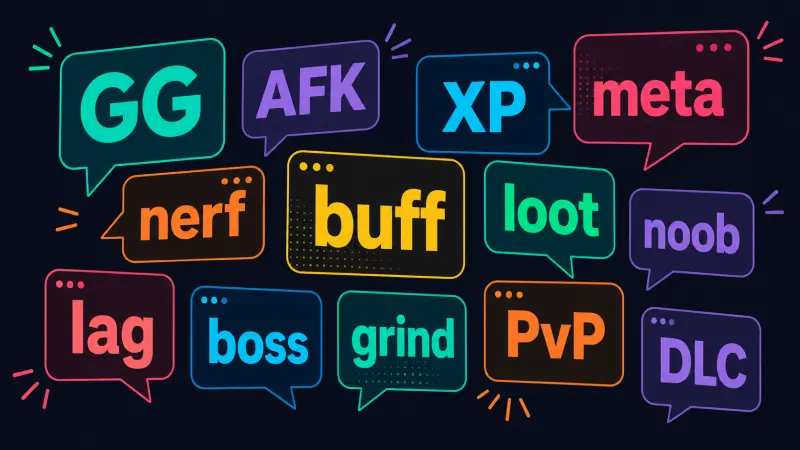
XP stands for experience points. You earn XP by completing tasks, defeating enemies, or finishing levels. Accumulate enough XP and your character levels up, gaining new abilities or becoming more powerful. Many games are built around the steady accumulation of XP as a core loop.
A boss is a powerful enemy placed at the end of a level or major section of a game. Bosses are substantially harder than regular enemies and usually require a specific strategy to defeat. Reaching and defeating a boss typically marks a significant point of progress.
A checkpoint or save point is a location in the game where your progress is recorded. If you die or quit after reaching one, you resume from there rather than from the beginning. Some games save automatically; others require you to find or activate a save point manually.
Loot refers to items, weapons, equipment, or currency found in the game world or dropped by defeated enemies. Collecting loot is central to many action and role-playing games. “Good loot” typically means items that meaningfully improve your character’s abilities.
What Developers Do
A patch is an update released by the game’s developer after launch that changes how the game works. Patches fix bugs, adjust gameplay balance, and sometimes add new content. Most games receive patches regularly, sometimes weekly.
A buff is when a patch makes something in the game stronger: a weapon does more damage, a character moves faster, an ability lasts longer. The opposite is a nerf, which weakens something. The word comes from the Nerf toy brand and is used informally to mean making something less dangerous. Both terms appear constantly in online discussions about competitive games.
DLC stands for downloadable content. It refers to additional material for a game sold separately from the main release. DLC can include new levels, story chapters, characters, or cosmetic items such as outfits or weapon skins.
How You Play
To grind is to repeat the same activity many times in order to earn XP, money, or items. A player might fight the same enemies repeatedly to level up their character before attempting a difficult section. Whether a game requires too much grinding is a common topic in reviews.
Speedrunning is the practice of completing a game as quickly as possible, using specific routes, shortcuts, or techniques to skip content. Speedrun communities exist for most major games, with leaderboards tracking the fastest recorded times. Watching speedruns has become a form of entertainment in its own right.
Rage quitting means leaving a game out of frustration, usually after losing or encountering something that feels unfair. It applies in both single-player and multiplayer games. The term is informal and not intended as a serious criticism.
AFK stands for away from keyboard. It means the player is not actively playing, even though their character may still be present in the game. In multiplayer games, an AFK player leaves their team short-handed. The term originated in PC gaming but is now used across all platforms.
A sandbox game gives players freedom to move through the world and do things in any order, rather than following a fixed path. Minecraft is the most widely known example. The opposite is a more linear game, where the story and levels progress in a fixed sequence.
Online and Multiplayer
PvP stands for player versus player. It refers to any mode where you compete directly against other human players. PvE stands for player versus environment, where you and other players cooperate against enemies controlled by the game. Many online games offer both modes.
GG stands for good game. Players type it in chat at the end of a match as a sign of respect, similar to a handshake after a sports match. GG WP means good game, well played. Typing GG before a match is over is generally considered disrespectful, as it implies you have already decided the outcome.
A noob (also written newb or newbie) is a new or inexperienced player. The term is sometimes used neutrally and sometimes as an insult, depending on context. In most communities, every player starts as a noob, including experienced players trying a new game for the first time.
The meta refers to the most effective strategies, characters, or equipment in a game at a given time. It changes whenever the developer releases a patch that adjusts balance. A character described as “meta” is one that most competitive players currently consider the strongest option. “Playing the meta” means using whatever the community has identified as optimal, rather than personal preference.
Lag is a delay between your input and what happens on screen, usually caused by a slow or unstable internet connection. High lag makes games difficult to play competitively and sometimes impossible to play at all. Ping measures your connection speed to the game’s server in milliseconds. A lower ping means a faster, more responsive connection.
Game Types
FPS stands for first-person shooter. You see the game world through the eyes of your character and the primary activity is shooting. Counter-Strike is one of the longest-running examples. FPS can also stand for frames per second, a measure of how smoothly a game runs. Context usually makes clear which meaning is intended.
An RPG is a role-playing game, where you develop a character over time through decisions, combat, and story. These games typically include XP systems, character customization, and narrative choices. An MMORPG is a massively multiplayer online RPG, where thousands of players share the same world simultaneously. World of Warcraft is the most widely recognized example globally.
Casual and hardcore describe how players approach games rather than the games themselves. A casual player plays for relaxation, in shorter sessions, without focusing on winning or completion. A hardcore player invests significant time and prioritizes mastery, competition, or finishing all available content. Most games are designed with both in mind.