
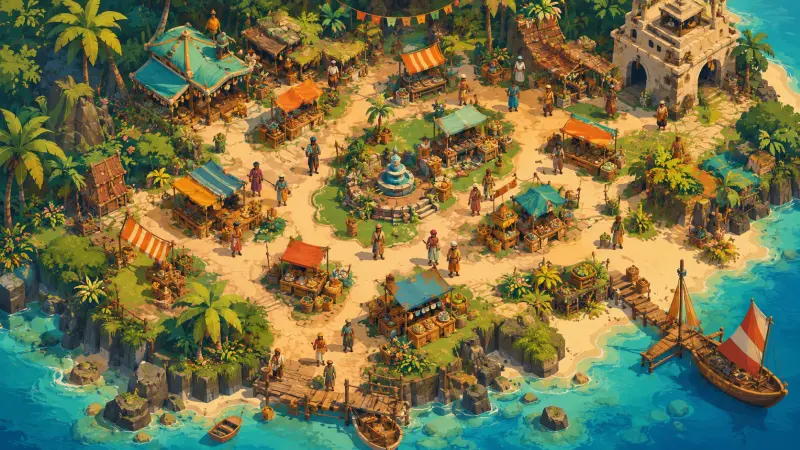
Smoothie Wars sets players up as rival smoothie entrepreneurs competing on a tropical island across a simulated week of business. The premise sounds light, but the economic structure underneath it is genuine. For the right group, it works considerably better than the cheerful packaging suggests.
The game was designed by UK entrepreneur Dr Thom Van Every, funded through Kickstarter, and published by Smoothie Games. It plays in 30 to 45 minutes with 3 to 8 players, and is suitable from age 12 upward.
How It Works
Each round represents one day of a six-day trading week. At the start of a turn, all players simultaneously and secretly select their location on the island map and choose which smoothies to sell. Once everyone has committed, choices are revealed and profits are calculated based on supply and demand: the more players selling the same product in the same location, the lower the returns for each of them. Making money requires anticipating what your competitors will do.
This is a basic microeconomics lesson delivered through play. Prices fall when supply exceeds demand. Setting up in a high-traffic area alongside three competitors is not the same as finding an underserved corner of the map. The game teaches this through repetition rather than instruction, which is its most consistent strength.
Cash management matters across the six rounds. Players who spend aggressively early may find themselves short when later days offer better opportunities. This forces some forward planning without making the game feel heavy.
What Works
The simultaneous action selection removes downtime. Everyone decides at the same time, and resolution is fast. This keeps the pace consistent regardless of player count, which is notable given that the design scales to eight players without apparent loss of balance. Many games at this weight struggle above five players.
The business concepts are accurate rather than decorative. Supply and demand, location strategy, and cash flow are not simplified to the point of being ornamental. Players familiar with basic economics will recognise the structure; players who are not will absorb it through play. That is a harder design achievement than it sounds.
There is also a social dimension worth noting. Because choices are revealed simultaneously each round, there is a moment where everyone discovers whether they correctly predicted the competition. That reveal generates genuine reactions, which most strategy games at this weight do not manage.
What Is Less Convincing
The theme does not carry deep weight. The tropical island and smoothie premise is pleasant but thin: it is a wrapper for the economic mechanics, not a world that enriches them. Players looking for narrative texture or thematic immersion will not find it here. This is a systems game dressed in a casual premise.
The six-round structure also means the game concludes quickly. Experienced players may find this satisfying, since each decision carries more weight when there are only six of them. Players who prefer longer strategic arcs may feel the game ends before they have fully explored their options. This is a design trade-off rather than a flaw, but it is worth knowing before you buy.
Critical coverage is limited. BoardGameGeek lists the game with positive community ratings, and Innovate Design praised its educational value and production quality. The game lacks the broader critical record that larger publisher titles generate, which makes independent assessment harder than usual.
Verdict
Smoothie Wars works best as a gateway strategy game for groups who want genuine decision-making without a steep learning curve. It delivers a functional economic game in a friendly, fast format. It is not for players who want depth, length, or narrative texture. For the audience it is designed for, it delivers what it promises.
Players: 3-8 | Play time: 30-45 minutes | Designer: Dr Thom Van Every | Publisher: Smoothie Games | Released: 2025