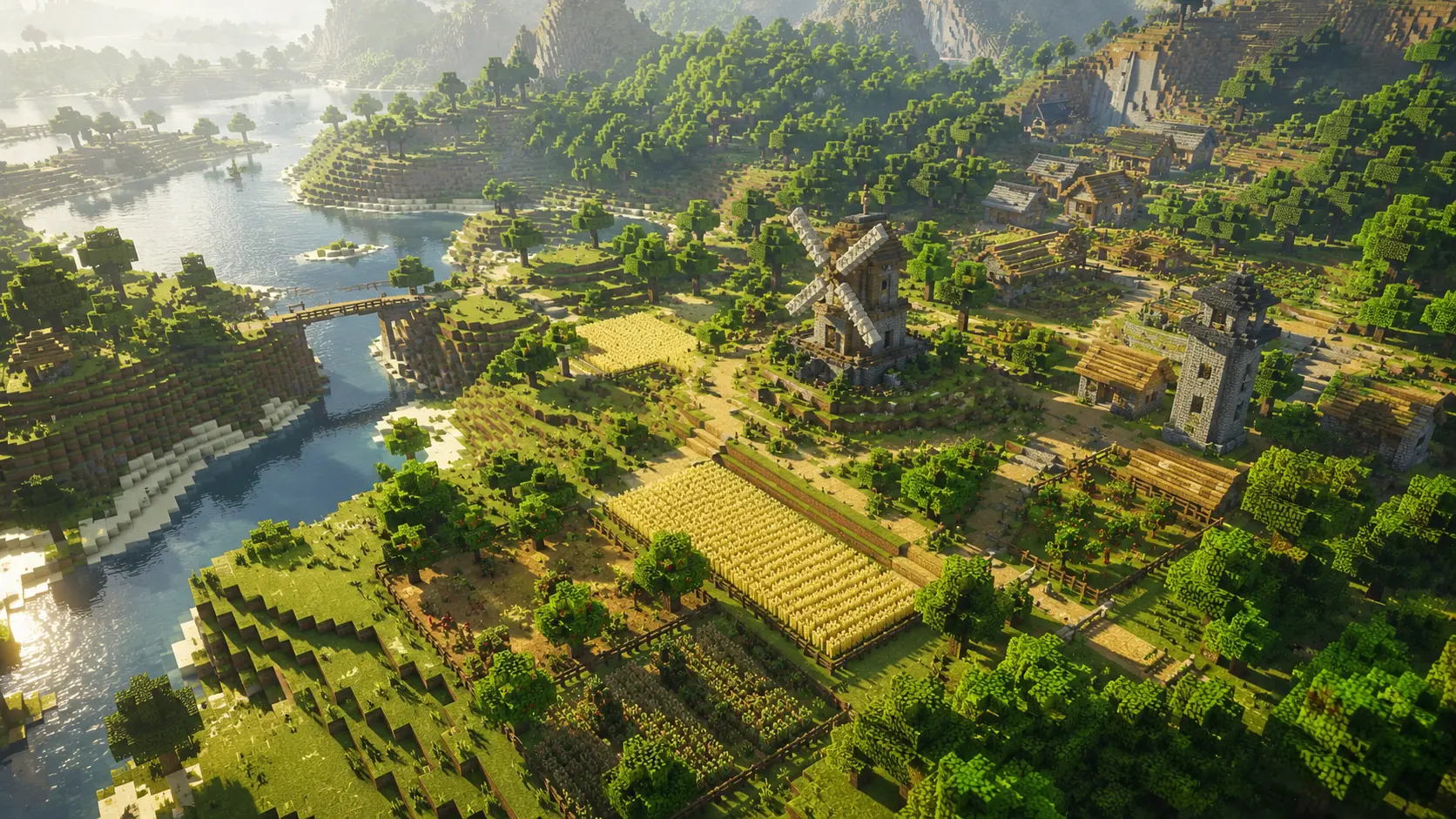
Minecraft came out in 2011. It is 2026. The game has over 212 million monthly active players and has sold more than 350 million copies worldwide, making it the best-selling video game in history. Monthly active players peaked at 222.5 million in June 2025, driven partly by the release of A Minecraft Movie — the third highest-grossing video game film ever made, earning $961 million at the global box office. Most games have a two-year shelf life. Minecraft has spent fifteen years getting bigger.
The question worth asking is not whether Minecraft is still popular. The numbers answer that. The interesting question is why.
What Minecraft actually is in 2026
Minecraft is not one thing. It is a platform that contains many different games depending on who is playing and how. Survival mode — gathering resources, building shelter, fighting monsters — is still the most popular format, played by 56% of active users. Creative mode, where players build without resource constraints, accounts for 29%. The server ecosystem, where players run community experiences ranging from competitive minigames to collaborative city-building projects, hosts over 40% of all multiplayer sessions.
The game runs on virtually everything. PC in two editions (Java and Bedrock), every major console, mobile, and even some smart televisions. Mobile alone accounts for approximately 46% of the total player base. This platform ubiquity is not accidental — it is the result of Microsoft’s Bedrock Edition strategy, which cross-platform enables play across most devices while maintaining a separate Java Edition for the PC community that prefers it.
Why it keeps growing
Three forces sustain Minecraft’s player count in ways that most games cannot replicate.
The first is the age of new players. Players aged 15 to 21 make up 43% of the Minecraft user base, with an average player age of 24 across all platforms. Children who would have been born after the game’s release are now its primary demographic. Minecraft is not aging with its original audience — it is continuously replenished by new ones. Every generation of children discovers it, apparently, and the discovery feels fresh to them regardless of the game’s age.
The second is the update cadence. Mojang has released major content updates to Minecraft continuously since launch. The Tricky Trials update and the 2026 Tiny Takeover update both contributed to the June 2025 player count spike. Each update brings back lapsed players and generates new content for creators and servers. The game never stops changing, even though its core identity has remained constant.
The third is the creator economy. Minecraft creators have earned over $500 million collectively from the Marketplace since its launch. The game’s modding community on Java Edition has produced thousands of free experiences that extend the game far beyond what Mojang could build alone. Servers like Hypixel host millions of players in entirely Minecraft-derived games that would be standalone products in any other context. The game has become an ecosystem, and ecosystems are substantially harder to kill than products.
The movie effect
A Minecraft Movie, released in 2025, is worth examining separately. The film earned $961 million globally and drove a measurable spike in player count — monthly active users peaked at 222.5 million in June 2025 in the months surrounding the release, up from 204 million the year before. The movie introduced the game to parents and older siblings who had not engaged with it directly, and converted passive familiarity into active play.
The film’s success also validated something the games industry has been trying to prove for decades: that video game adaptations can be mainstream entertainment rather than fan service. It joins The Super Mario Bros. Movie and Sonic the Hedgehog as evidence that the right adaptation of the right property can generate genuine crossover audiences.
What keeps it from being everything
Minecraft’s dominance in the under-21 demographic comes at the cost of presence in older player conversations. The game is rarely discussed as part of the enthusiast gaming discourse that drives review scores and gaming media coverage — it is too popular, too accessible, and too associated with children to receive the critical attention it would warrant if it were a new game today.
The Java/Bedrock split also creates ongoing friction. Java Edition players and Bedrock Edition players cannot play together, which creates community divisions and periodic frustration that Microsoft has been slowly working to address without fully resolving. The two editions have meaningfully different feature sets, mod compatibility, and community cultures.
Fifteen years is a long time
No other commercial video game has sustained this level of active engagement at this age. World of Warcraft, the previous benchmark for game longevity, launched in 2004 and still has players but nothing approaching 212 million monthly actives. Minecraft’s combination of infinite replayability, platform accessibility, continuous updates, creator economy, and perpetual audience renewal has produced something genuinely anomalous in the history of entertainment software.
At some point, presumably, the numbers will plateau or decline. That point has not arrived yet.