
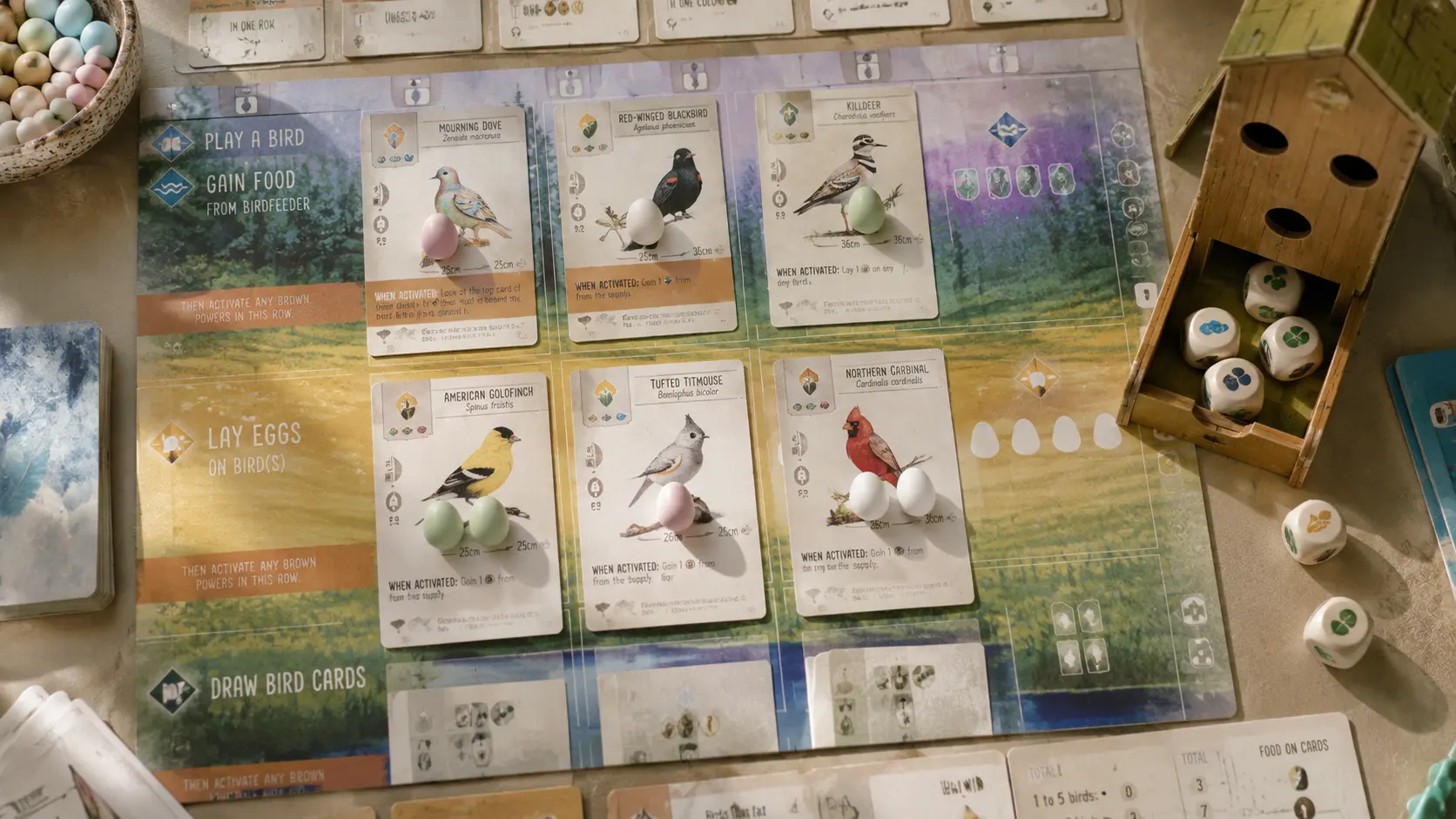
Wingspan came out in 2019. It won the Kennerspiel des Jahres — the German award for complex hobby games — that year, sold 200,000 copies within twelve months, and spent the next several years being the game people pointed to when they wanted to explain what modern board gaming actually looks like to someone who had never seen it. The base game and its expansions have now collectively sold over 2.4 million copies, with the full “span” trilogy including Wyrmspan and Finspan exceeding 3.3 million lifetime copies as of early 2026. For a hobby board game — a category where 10,000 copies is a solid run — these are extraordinary numbers.
The question in 2026 is not whether Wingspan is good. That has been settled. The question is whether it is still the right first recommendation for someone new to strategy gaming, in a market that has grown considerably since Wingspan defined the category.
What it is
Wingspan is an engine-building card game for one to five players, designed by Elizabeth Hargrave and published by Stonemaier Games. Players are bird enthusiasts competing to attract the most valuable birds to their wildlife preserves. Each preserve has three habitats — forest, grassland, and wetland — and each bird card played to a habitat extends a chain of actions that activates other birds already in that row. Playing a bird in your wetland might trigger three other wetland birds in sequence, each producing food, eggs, or cards. Getting those chains to fire efficiently is the game.
The theme is not a skin on top of a generic mechanism. Hargrave researched real birds and designed their card abilities around actual behaviors — birds that cache food have storage abilities, migratory birds trigger bonuses when moved, predators can tuck other bird cards beneath them to represent hunting. The coherence between theme and mechanics is part of what makes the game memorable rather than just functional.
How a game plays
Each round, players have a decreasing number of actions — four in round one, then three, two, and one — which creates natural time pressure without a clock. On your turn you do one of four things: play a bird card from your hand, gain food from the birdfeeder dice tower, lay eggs, or draw more bird cards. Each action in a habitat activates the chain of birds already there. In the early game those chains are short and weak. By round four, a well-built engine produces cascades of resources that feel genuinely satisfying.
Scoring comes from birds in your preserve, eggs on those birds, cached food, tucked cards, and end-round goals shared across all players. The combination of personal engine-building and shared objectives creates a push-pull that keeps players engaged in what others are doing without making the game feel adversarial.
Setup takes roughly 10 minutes once you know what you are doing. A full game at two players takes 45 to 60 minutes. At five players, expect 90 minutes.
What works
GamesRadar called it “one of the greats” in a review updated through October 2025, noting that its execution “is so close to being perfect.” The consistency of that kind of praise across six years and across player demographics is unusual. Wingspan works for non-gamers who need a gentle entry point, for experienced players who want to optimize engines, for families with teenagers, and for solo players who want a meditative evening game. The adjustable difficulty and optional automa system for solo play cover a wider range of situations than most games manage.
The components are exceptional for the price. The birdfeeder dice tower — a cardboard house through which you roll custom food dice — is a small piece of physical theatre that players consistently mention as a highlight. The watercolor bird illustrations across 170 unique cards are beautiful in a way that functional game components rarely are. The storage solution, with molded plastic trays for food tokens and eggs, makes setup and teardown faster than comparably complex games.
What does not
The legitimate criticism of Wingspan is that it plays somewhat solitaire. Your engine operates largely in isolation from other players, and while shared end-round goals create some indirect competition, there is very little direct interaction. Players optimizing their own preserve may barely affect what opponents are doing. For players who want confrontation, negotiation, or the ability to disrupt a rival’s plans, Wingspan is the wrong game.
The birdfeeder dice tower, while charming, is also fragile and reassembling it after it inevitably collapses mid-game is a minor irritation in an otherwise smooth experience. Experienced Wingspan players often replace it with a wooden version sold separately.
The randomness of card draw can produce occasional games that feel decided by luck more than skill — an exceptional bird drawn early shapes an entire strategy, and not drawing one when an opponent does creates a gap that is difficult to recover from. This matters more at higher player counts than at two.
Where it stands in 2026
Stonemaier has released two spiritual successors since Wingspan: Wyrmspan, which swaps birds for dragons and tightens several of Wingspan’s frustration points, and Finspan, which features aquatic life and a different structural twist. Both have sold well. The Dice Tower noted that Wyrmspan eliminated several sources of frustration found in Wingspan — the egg spamming problem in particular — while feeling harder and more strategic. Experienced Wingspan players frequently recommend Wyrmspan as the better game for those who already know the system.
That creates a reasonable question about entry order. For someone with no board game background, Wingspan remains the cleaner starting point — its theme is more immediately accessible, its mechanics are gentler, and its reputation means learning resources are abundant. For someone who has played a few strategy games and wants more friction, Wyrmspan may be the better first purchase.
The verdict
Wingspan is still the best single recommendation for someone new to hobby board games who wants a strategy game that is genuinely beautiful, thematically coherent, and accessible without being shallow. The solitaire criticism is real and worth knowing about in advance. The lack of direct conflict is a feature for some players and a dealbreaker for others — figure out which camp you are in before buying.
For players who already own it: the base game holds up. An expansion — the European expansion is the most complementary to the base game, adding new birds and a revised end-round goal mechanism — extends the experience meaningfully without requiring a new ruleset.
For players considering Wyrmspan or Finspan instead: both are worth it if you already know the system. As a first game for a new player, start with Wingspan.
Players: 1 to 5
Play time: 40 to 70 minutes
Designer: Elizabeth Hargrave
Publisher: Stonemaier Games
Released: 2019 (current edition 2024)
BGG ranking: 25 to 27 overall (2025)